
Tamdi Surla, Goa —
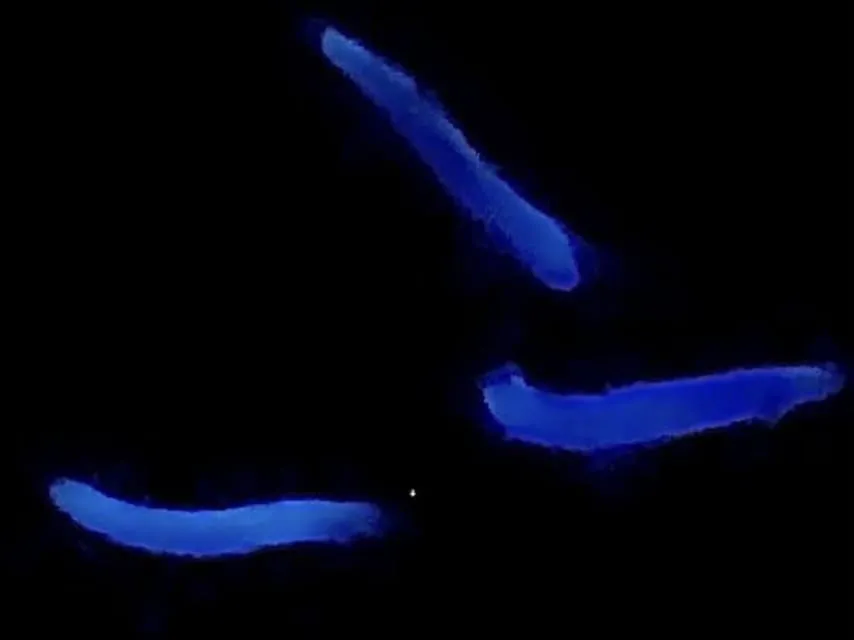
India’s Western Ghats are no strangers to bioluminescence — but almost all of it, until now, has come from fungi, not animals. A recent sighting from the Tamdi Surla forests in Goa’s Western Ghats foothills may change that picture, with the documentation of glowing insect larvae identified as belonging to the fungus-gnat family Keroplatidae (order Diptera).
The organisms were photographed by Wetland Mitra Adv. Shashikant Naik around 8 pm on 25th August 2026, while walking through the forest in pitch darkness, accompanied by his wife Geeta and Loven Pereira. “They look fantastic when you see them in pitch dark,” Naik said, adding that the larvae were moving too much to be captured on video. The images were examined and identified by Dr. Nandkumar M. Kamat, Independent Scientist and Microbial Consultant to the Goa State Biodiversity Board, who confirmed the glowing organisms as larvae of the genus Keroplatus or a closely allied keroplatine, and tentatively identified the host bracket fungus as Stereum ostrea (false turkey-tail), pending hymenophore and microscopic confirmation.
Dr Kamat brings a long track record to this identification. Over successive monsoon seasons, he has documented several genera and species of bioluminescent fungi from Goa, including Neonothopanus, Roridomyces, Omphalotus japonicus, Omphalotus olearius, Omphalotus nidiformis, Mycena chlorophos, and Armillaria mellea. He has also worked on Goa’s local fireflies and their larvae, giving him a working familiarity with both fungal and insect bioluminescence in the state’s forests — a background that placed him well to recognise the Tamdi Surla larvae as something distinct from the glowing fungi he has spent years documenting.
India already has a reasonably well-documented record of bioluminescent fungi from the Western Ghats and neighbouring hill forests, several of them among the very genera and species Dr Kamat has himself recorded in Goa. All of these are cases of fungal tissue itself producing light on decaying wood.
Animal bioluminescence of the kind seen at Tamdi Surla is a distinct phenomenon: here it is the insect larva — not the fungus — that produces light, while using the fungus only as habitat and food source. A search of the available literature turned up no confirmed living record of bioluminescent keroplatid fungus-gnat larvae from India. The only prior Indian connection to this insect family is palaeontological: a fossil keroplatid species, Vastaplatyura electrica, was described from Lower Eocene amber found at Vastan in Gujarat — evidence that the family has an ancient presence on the subcontinent, but not a living, light-emitting one.
Confirmed living records of bioluminescent keroplatid larvae worldwide remain limited to a handful of regions: the glowworms of New Zealand’s Waitomo Caves (Arachnocampa luminosa), stream banks of the Appalachian Mountains in the United States (Orfelia fultoni), certain Eurasian Keroplatus species, and — in the most recent addition to the global list, described only in 2019 — Neoceroplatus betaryiensis from the Atlantic Forest of Brazil, the first such record for South America. If confirmed through specimen-level study, the Tamdi Surla larvae would represent one of very few such records anywhere in Asia outside the established Eurasian Keroplatus range, and potentially the first documented instance from the Indian subcontinent.
“Within Goa specifically, prior documentation of terrestrial bioluminescence has centred almost entirely on fungi. No animal bioluminescence of this kind appears to have been recorded from the state before — and going by the available literature, possibly not from India either. The Tamdi Surla forest tract in the Western Ghats deserves close monitoring,” Dr Kamat said.
Why Scientists Elsewhere Would Be Interested
Beyond its novelty for India, a find like this matters to scientists who study how and why living things glow. Nobody yet fully understands the chemical reaction that makes these particular fly larvae light up — it may or may not be the same reaction used by fireflies, or by glowing mushrooms, or by the cave glow-worms of New Zealand. Every new population found in a new part of the world, especially one as far from the previously known sites as the Western Ghats, gives researchers another sample to compare, and could help answer whether all these glowing flies evolved their light from one common ancestor or “invented” it separately, several times over, in different parts of the world.
There is also a practical angle. Glowing proteins from fireflies and jellyfish have already given science some of its most useful laboratory tools, letting researchers light up and track processes inside living cells. The chemistry behind fly larvae like this one has barely been studied, which is exactly what makes a fresh, well-documented sighting from an under-explored forest like Tamdi Surla scientifically valuable — quite apart from how striking it looks in the dark.
The larvae’s association with a bracket fungus is consistent with the mycophagous habit reported for Keroplatus-type larvae elsewhere, which shelter under fungal fruiting bodies and feed on fungal spores. Their presence is considered indicative of an undisturbed, moist, fungus-rich forest microhabitat, adding a previously undocumented element to the nocturnal biodiversity profile of the Tamdi Surla forest tract in the Western Ghats.
Identification of larvae and fungus (tentative): Dr. Nandkumar M. Kamat. Field photographs: Wetland Mitra Adv. Shashikant Naik.
Dr. Nandkumar M. Kamat
Consultant, Microbial Diversity
Goa State Biodiversity Board